Performance
Everyday workloads at 100,000 and 1,000,000 rows, each driver in its own process against the same MySQL 8.4 on the same machine, over plain TCP. The more rows an application reads or writes, the bigger the difference. When the time goes into the network round trip of many tiny queries, or into building ORM objects one by one, every driver gets closer to the others.
mysql-connector-python runs with its C extension, on Python 3.14 (it has none
for 3.15 yet). The asyncio sections compare rustmy.aio with asyncmy,
aiomysql and mysql.connector.aio.
Where the numbers come from
The charts and tables below are generated by benches/showcase.py and
are the same as in the README, for the last release measured. Open
Numbers under each chart for the table.
CPython 3.14.3 · MySQL 8.4.13 · Darwin arm64 · rustmy 1.4.0, mysqlclient 2.3.1, PyMySQL 2.2.8, mysql-connector-python 26.10.0 (C extension), SQLAlchemy 2.1.9, Django 6.1.3 · best of 5 (100k) and 3 (1M) · 2026-11-26T11:14:45+00:00
DB-API
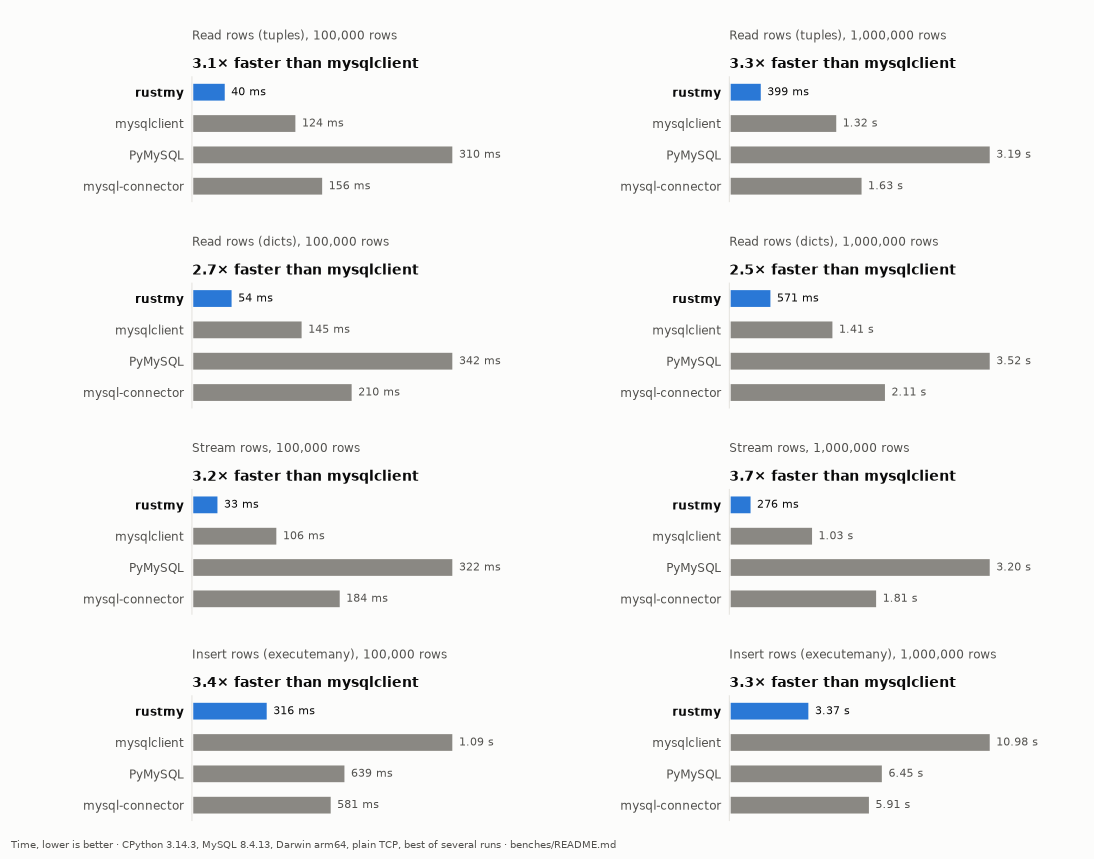
Numbers
| Workload | Rows | rustmy | mysqlclient | PyMySQL | mysql-connector | vs mysqlclient |
|---|---|---|---|---|---|---|
| Read rows (tuples) | 100,000 | 40 ms | 124 ms | 310 ms | 156 ms | 3.1× faster |
| Read rows (dicts) | 100,000 | 54 ms | 145 ms | 342 ms | 210 ms | 2.7× faster |
| Stream rows | 100,000 | 33 ms | 106 ms | 322 ms | 184 ms | 3.2× faster |
| Insert rows (executemany) | 100,000 | 316 ms | 1.09 s | 639 ms | 581 ms | 3.4× faster |
| Read rows (tuples) | 1,000,000 | 399 ms | 1.32 s | 3.19 s | 1.63 s | 3.3× faster |
| Read rows (dicts) | 1,000,000 | 571 ms | 1.41 s | 3.52 s | 2.11 s | 2.5× faster |
| Stream rows | 1,000,000 | 276 ms | 1.03 s | 3.20 s | 1.81 s | 3.7× faster |
| Insert rows (executemany) | 1,000,000 | 3.37 s | 10.98 s | 6.45 s | 5.91 s | 3.3× faster |
Prepared statements
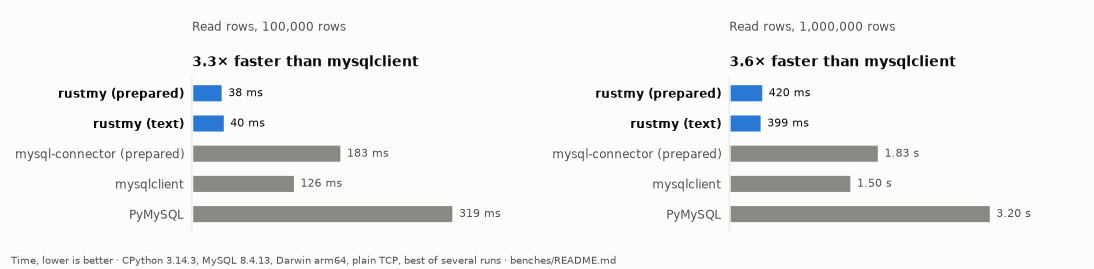
Numbers
| Workload | Rows | rustmy (prepared) | rustmy (text) | mysql-connector (prepared) | mysqlclient | PyMySQL | vs mysqlclient |
|---|---|---|---|---|---|---|---|
| Read rows | 100,000 | 38 ms | 40 ms | 183 ms | 126 ms | 319 ms | 3.3× faster |
| Read rows | 1,000,000 | 420 ms | 399 ms | 1.83 s | 1.50 s | 3.20 s | 3.6× faster |
SQLAlchemy 2
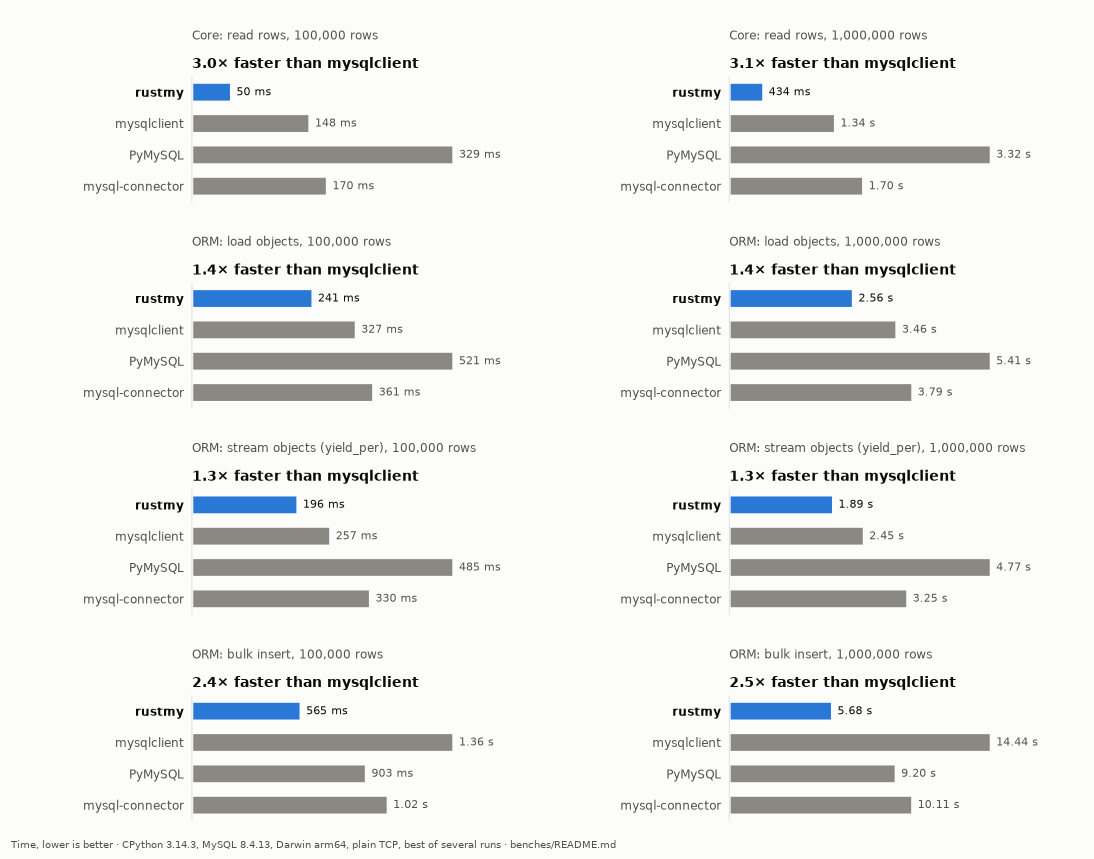
Numbers
| Workload | Rows | rustmy | mysqlclient | PyMySQL | mysql-connector | vs mysqlclient |
|---|---|---|---|---|---|---|
| Core: read rows | 100,000 | 50 ms | 148 ms | 329 ms | 170 ms | 3.0× faster |
| ORM: load objects | 100,000 | 241 ms | 327 ms | 521 ms | 361 ms | 1.4× faster |
| ORM: stream objects (yield_per) | 100,000 | 196 ms | 257 ms | 485 ms | 330 ms | 1.3× faster |
| ORM: bulk insert | 100,000 | 565 ms | 1.36 s | 903 ms | 1.02 s | 2.4× faster |
| Core: read rows | 1,000,000 | 434 ms | 1.34 s | 3.32 s | 1.70 s | 3.1× faster |
| ORM: load objects | 1,000,000 | 2.56 s | 3.46 s | 5.41 s | 3.79 s | 1.4× faster |
| ORM: stream objects (yield_per) | 1,000,000 | 1.89 s | 2.45 s | 4.77 s | 3.25 s | 1.3× faster |
| ORM: bulk insert | 1,000,000 | 5.68 s | 14.44 s | 9.20 s | 10.11 s | 2.5× faster |
Django
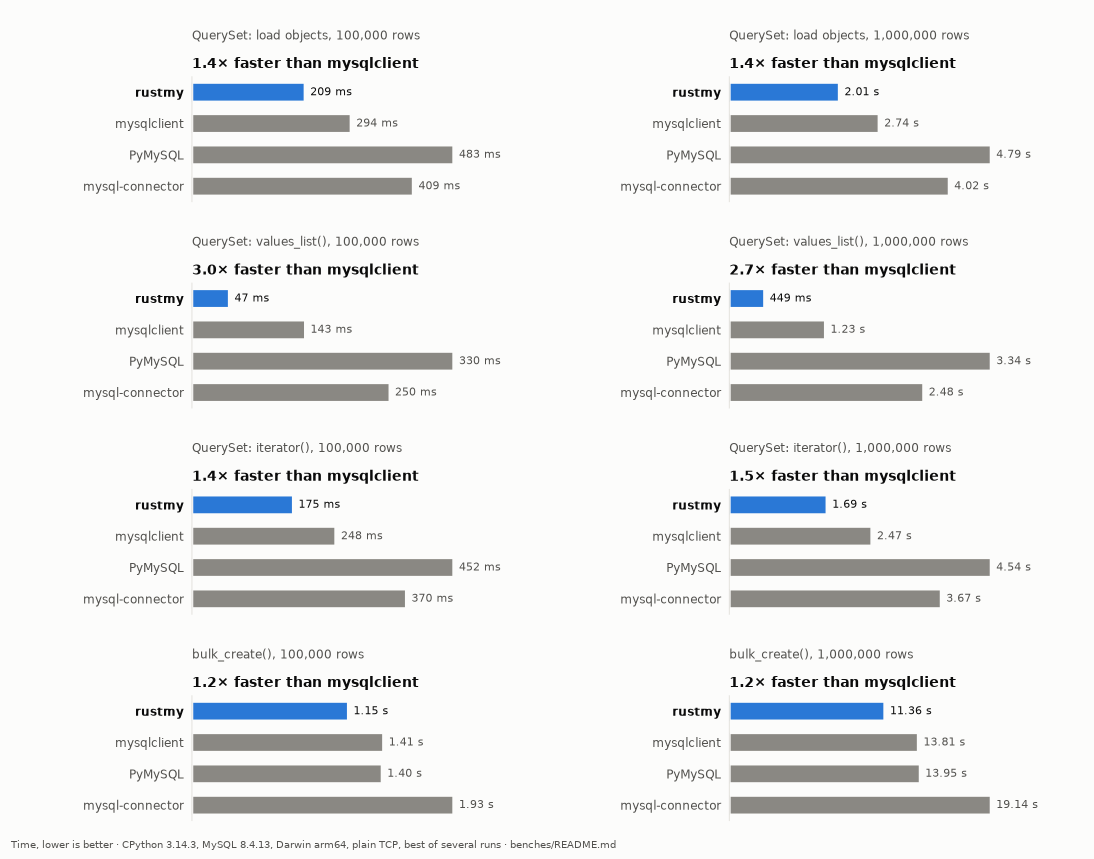
Numbers
| Workload | Rows | rustmy | mysqlclient | PyMySQL | mysql-connector | vs mysqlclient |
|---|---|---|---|---|---|---|
| QuerySet: load objects | 100,000 | 209 ms | 294 ms | 483 ms | 409 ms | 1.4× faster |
| QuerySet: values_list() | 100,000 | 47 ms | 143 ms | 330 ms | 250 ms | 3.0× faster |
| QuerySet: iterator() | 100,000 | 175 ms | 248 ms | 452 ms | 370 ms | 1.4× faster |
| bulk_create() | 100,000 | 1.15 s | 1.41 s | 1.40 s | 1.93 s | 1.2× faster |
| QuerySet: load objects | 1,000,000 | 2.01 s | 2.74 s | 4.79 s | 4.02 s | 1.4× faster |
| QuerySet: values_list() | 1,000,000 | 449 ms | 1.23 s | 3.34 s | 2.48 s | 2.7× faster |
| QuerySet: iterator() | 1,000,000 | 1.69 s | 2.47 s | 4.54 s | 3.67 s | 1.5× faster |
| bulk_create() | 1,000,000 | 11.36 s | 13.81 s | 13.95 s | 19.14 s | 1.2× faster |
Memory
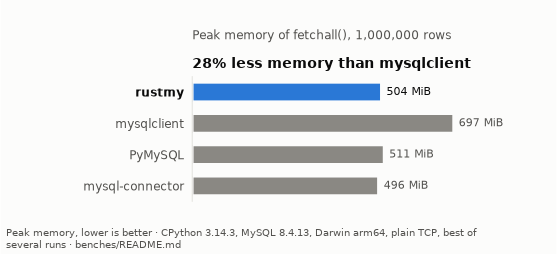
Numbers
| Workload | Rows | rustmy | mysqlclient | PyMySQL | mysql-connector | vs mysqlclient |
|---|---|---|---|---|---|---|
| Peak memory of fetchall() | 1,000,000 | 504 MiB | 697 MiB | 511 MiB | 496 MiB | 28% less memory |
asyncio: asyncmy 0.2.18, aiomysql 0.3.2 and mysql.connector.aio (mysql-connector-python 26.10.0, pure Python), on asyncio's default event loop; compared with asyncmy, the fastest of them. mysql.connector.aio's pool fails instead of waiting when no connection is idle, so it has no pool figure; SQLAlchemy has no asyncio dialect for it.
asyncio

Numbers
| Workload | Rows | rustmy | asyncmy | aiomysql | mysql.connector.aio | vs asyncmy |
|---|---|---|---|---|---|---|
| Read rows (tuples) | 100,000 | 40 ms | 35 ms | 371 ms | 454 ms | 1.1× slower |
| Read rows (dicts) | 100,000 | 50 ms | 60 ms | 405 ms | 510 ms | 1.2× faster |
| Stream rows | 100,000 | 58 ms | 61 ms | 397 ms | 606 ms | 1.1× faster |
| Insert rows (executemany) | 100,000 | 342 ms | 538 ms | 630 ms | 1.07 s | 1.6× faster |
| Read rows (tuples) | 1,000,000 | 342 ms | 374 ms | 3.84 s | 4.66 s | 1.1× faster |
| Read rows (dicts) | 1,000,000 | 555 ms | 719 ms | 4.14 s | 5.17 s | 1.3× faster |
| Stream rows | 1,000,000 | 540 ms | 563 ms | 3.97 s | 6.00 s | on par with asyncmy |
| Insert rows (executemany) | 1,000,000 | 3.76 s | 5.49 s | 6.37 s | 10.20 s | 1.5× faster |
| Pool: 32 tasks, 8 connections | 6,400 queries | 191 ms | 186 ms | 413 ms | n/a | on par with asyncmy |
SQLAlchemy 2, asyncio
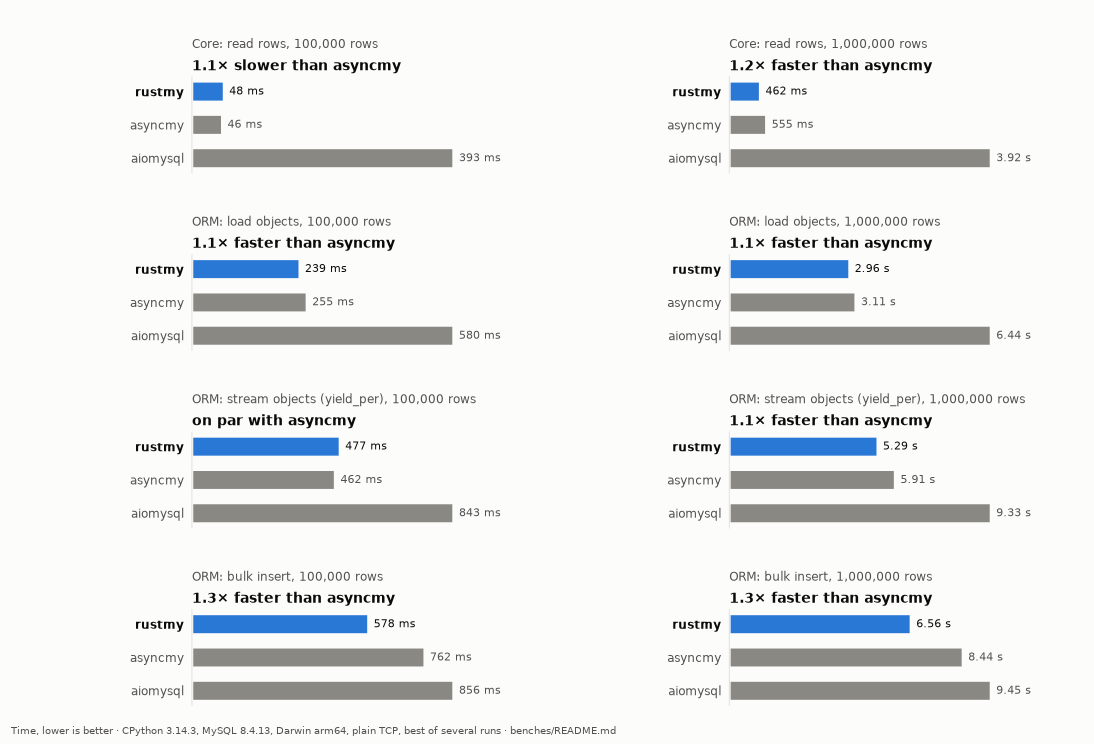
Numbers
| Workload | Rows | rustmy | asyncmy | aiomysql | vs asyncmy |
|---|---|---|---|---|---|
| Core: read rows | 100,000 | 48 ms | 46 ms | 393 ms | 1.1× slower |
| ORM: load objects | 100,000 | 239 ms | 255 ms | 580 ms | 1.1× faster |
| ORM: stream objects (yield_per) | 100,000 | 477 ms | 462 ms | 843 ms | on par with asyncmy |
| ORM: bulk insert | 100,000 | 578 ms | 762 ms | 856 ms | 1.3× faster |
| Core: read rows | 1,000,000 | 462 ms | 555 ms | 3.92 s | 1.2× faster |
| ORM: load objects | 1,000,000 | 2.96 s | 3.11 s | 6.44 s | 1.1× faster |
| ORM: stream objects (yield_per) | 1,000,000 | 5.29 s | 5.91 s | 9.33 s | 1.1× faster |
| ORM: bulk insert | 1,000,000 | 6.56 s | 8.44 s | 9.45 s | 1.3× faster |
Why it is fast
- Batches with the GIL released. Rows are read in batches of about 4 KiB with the GIL released, and each batch is converted in Rust while the server sends the next one: network and conversion overlap.
- No intermediate objects. Values go straight from the wire to Python
objects;
date,datetimeandtimedeltaare built directly, and dict rows are built in Rust with their keys created once per result. - Out of the garbage collector. Tuple rows of atomic values (numbers,
text, bytes, dates,
None,Decimal) are untracked as they are built, so collections during a large read do not traverse every row read so far. - Fewer round trips.
executemanybatchesINSERT … VALUESinto multi-row statements and pipelines everything else.
More scenarios
How it was measured, more scenarios (character sets, conv=, cursors,
compression over slow links, pipelining with latency) and the history of
every optimization are in the
benchmark notes.
Every pull request is also measured on
CodSpeed.